
The Evolution of RAG: From Simple Retrieval to Intelligent Agent Memory
From the archive: first published on the original PCT WordPress blog on 4 November 2025.
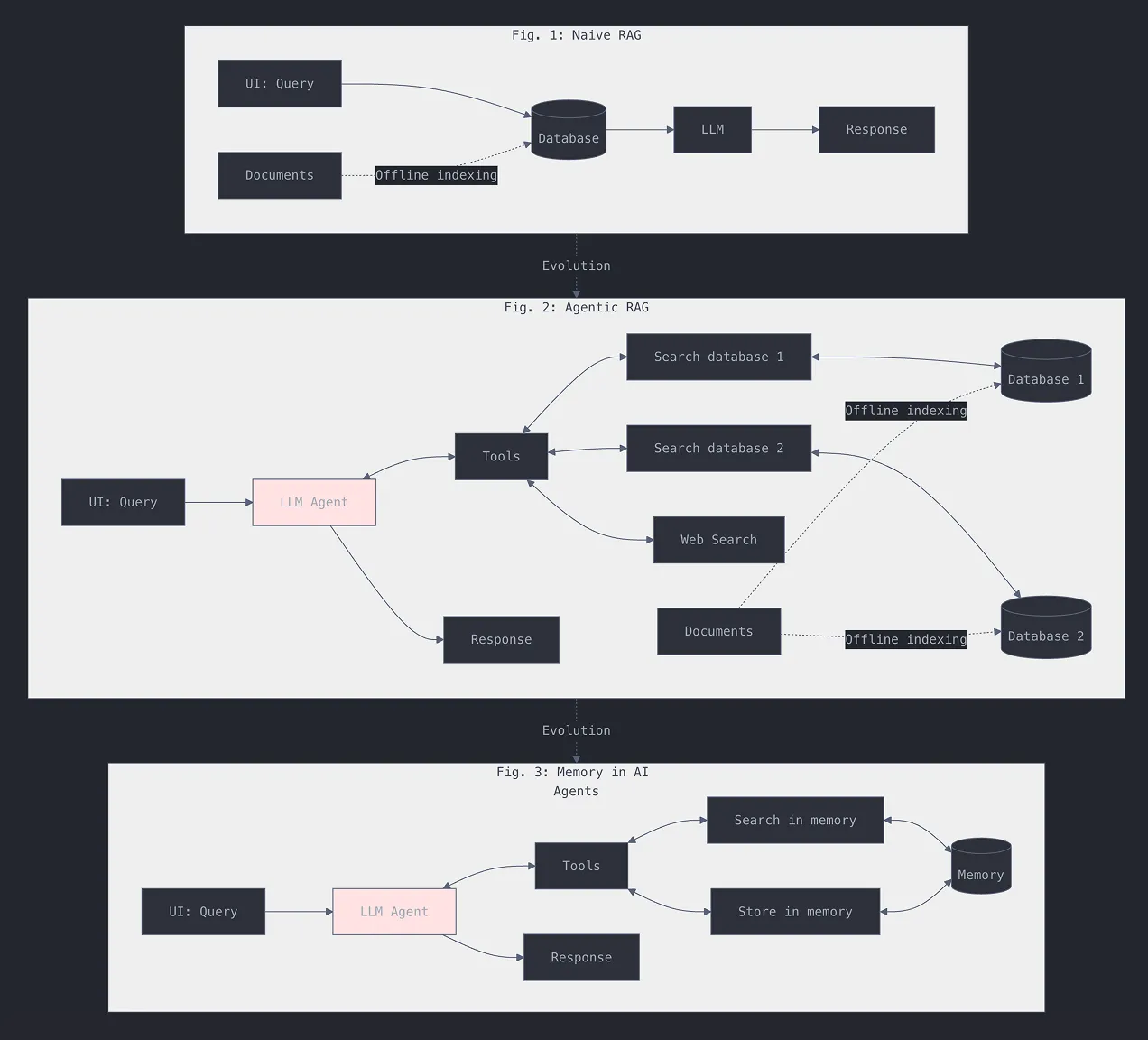
The landscape of AI-powered information retrieval has undergone a remarkable transformation in recent years. What started as basic document search has evolved into sophisticated agentic systems with persistent memory. This article traces that journey through three key stages: Naive RAG, Agentic RAG, and Memory in AI Agents.
Stage 1: Naive RAG – The Foundation
Retrieval-Augmented Generation (RAG) emerged as a breakthrough approach to give large language models access to external knowledge. The concept was elegantly simple: instead of relying solely on the model’s training data, we could retrieve relevant information from a database and feed it to the LLM alongside the user’s query.
How it works:
The naive RAG architecture follows a straightforward pipeline. Documents are indexed offline into a vector database, creating searchable embeddings of the content. When a user submits a query, the system searches this database for relevant passages, retrieves them, and passes both the query and retrieved context to the LLM. The model then generates a response informed by this external knowledge.
Limitations:
While revolutionary, naive RAG had significant constraints. It operated as a single-shot system with no decision-making capability. Every query triggered the same retrieval process regardless of whether it was actually needed. The system couldn’t adapt its search strategy, combine information from multiple sources, or determine when retrieval was unnecessary. It was essentially a rigid pipeline: query in, search database, generate answer, done.
Stage 2: Agentic RAG – Adding Intelligence
Agentic RAG represented a paradigm shift by transforming the LLM from a passive responder into an active agent capable of tool use and strategic decision-making.
The agent framework:
In this architecture, the LLM becomes an agent with access to multiple tools. Rather than blindly searching a single database, the agent can now:
- Decide which tools to use based on the query
- Search across multiple specialized databases
- Perform web searches when internal knowledge isn’t sufficient
- Chain multiple tool calls together to gather comprehensive information
- Determine when no external retrieval is needed at all
Why this matters:
Agentic RAG dramatically improved answer quality and efficiency. An agent could recognize that a factual question might need a web search for current information, while a technical query might require searching specialized documentation databases. It could also make multiple searches to triangulate information or verify facts across sources.
Still read-only:
Despite these advances, agentic RAG remained fundamentally read-only. Each interaction was stateless. The agent could read from various sources but couldn’t learn from interactions or build up knowledge over time. Every conversation started from scratch with no memory of previous exchanges.
Stage 3: Memory in AI Agents – The Next Frontier
The addition of memory capabilities transforms agents from sophisticated search tools into systems that can truly learn and evolve through interactions.
Read and write operations:
Memory-enabled agents have tools that allow both retrieval and storage. The agent can now:
- Search its memory for relevant past interactions
- Store new information, insights, or user preferences
- Build up a knowledge base specific to the user or context
- Reference previous conversations and decisions
- Learn patterns and improve over time
The game-changer:
Memory fundamentally changes the agent’s relationship with information. Instead of treating each query in isolation, the agent can now:
Maintain context across sessions: An agent helping with a project can remember decisions made weeks ago and maintain consistency with previous recommendations.
Personalize interactions: By storing user preferences, communication styles, and domain knowledge, the agent can provide increasingly tailored assistance over time.
Accumulate expertise: Rather than starting fresh each time, the agent builds a corpus of problem-solving approaches, successful strategies, and domain-specific insights.
Improve efficiency: Frequently accessed information can be stored in memory rather than retrieved repeatedly from external sources.
The Evolutionary Pattern
Looking at these three stages reveals a clear progression:
Naive RAG: One-shot, read-only, rigid pipeline
- Query → Search database → Generate answer
Agentic RAG: Multi-step, read-only, flexible tool use
- Query → Agent decides strategy → Multiple tool calls → Generate answer
Agent Memory: Multi-step, read-write, persistent learning
- Query → Agent searches memory and external tools → Generate answer → Store insights
Each stage builds on the previous one while addressing fundamental limitations. The evolution mirrors how human knowledge work actually functions: we don’t just look things up in isolation, we use multiple sources strategically, and we remember what we learn.
Practical Implications
For developers:
Memory introduces new architectural considerations. How much should be stored? How should memory be structured and indexed? What are the privacy and security implications? When should information be forgotten? These questions require thoughtful design decisions that go beyond simple RAG implementations.
For users:
Memory-enabled agents offer a fundamentally different experience. Instead of repetitive interactions where you constantly re-establish context, the agent becomes a genuine assistant that knows your projects, preferences, and history. The quality of assistance can compound over time rather than resetting with each session.
For AI capabilities:
This evolution represents a shift from stateless information retrieval to stateful intelligent assistance. We’re moving from tools that answer questions to systems that can genuinely collaborate on complex, long-term tasks.
Challenges and Considerations
Privacy and control:
With memory comes responsibility. Users need transparency about what’s being stored, control over their data, and confidence that sensitive information is protected.
Memory management:
Not everything should be remembered forever. Effective memory systems need strategies for prioritizing important information, forgetting outdated or irrelevant data, and managing storage efficiently.
Consistency and accuracy:
As agents build up stored knowledge, ensuring that information remains accurate and consistent becomes critical. Memory systems need mechanisms to update or correct stored information when necessary.
Looking Forward
The evolution from RAG to agentic RAG to agent memory represents significant progress, but it’s unlikely to be the final form. Future developments might include:
- Collaborative memory systems where multiple agents can share and build on knowledge
- Hierarchical memory architectures that separate working memory from long-term storage
- More sophisticated forgetting mechanisms that mimic human memory patterns
- Integration with external knowledge graphs and structured databases
- Meta-learning capabilities where agents optimize their own memory and retrieval strategies
Conclusion
The journey from naive RAG to memory-enabled agents illustrates a fundamental truth about AI development: the most powerful advances often come from combining existing capabilities in new ways rather than entirely novel algorithms. By moving from simple retrieval to strategic tool use to persistent memory, we’ve transformed LLMs from impressive but stateless text generators into systems that can genuinely assist with complex, ongoing work.
This evolution isn’t just about technical capability; it’s about creating AI systems that work the way humans actually think and collaborate. We don’t just look up information in isolation—we strategize about where to find what we need, and we remember what we learn. Now our AI assistants can do the same.
As these memory-enabled agentic systems mature, they promise to reshape how we interact with AI: from asking questions and getting answers to building genuine working relationships with assistants that grow more capable over time. That’s not just an evolution in architecture—it’s an evolution in what AI assistance can be.